

Does sugar really make your PCOS worse?
Polycystic ovary syndrome (PCOS) affects millions of women worldwide, yet it remains one of the most misunderstood hormonal conditions. One of the most common questions women with PCOS ask is:
“Can sugar really make my PCOS worse, or is it just another food myth?”
If you have ever been told to just cut the sugar without saying why, then you are not alone.
Sugar is often blamed for everything from weight gain to hormonal imbalance. In this blog, you will get to know the real relationship between sugar and PCOS and how sugar affects hormones, insulin, weight, fertility, mental health, and whether completely avoiding sugar is truly necessary.
Before going into the depths of sugar making PCOS worse or not, let’s start with the basics first.
What is PCOS?
Polycystic ovary syndrome (PCOS) is a hormonal disorder that affects women of reproductive age. PCOS is commonly associated with some body changes in a woman.
Here are some of the changes you have if you have PCOS:
- Irregular or missed periods
- High androgen levels (male hormones)
- Ovarian cysts
- Weight gain or difficulty in losing weight
- Acne and excess facial or body hair
- Insulin resistance
While the exact cause of PCOS is still unknown, insulin resistance and hormonal imbalance are some key contributors to PCOS.
What will happen to your body if you eat sugar?
When you consume sugar, whether it is from sweets, desserts, sodas, or refined carbohydrates, it will quickly raise your blood glucose levels.
Your body responds by releasing insulin, a hormone that helps to move your sugar from your bloodstream into cells for energy, and this process doesn’t work smoothly if you have PCOS.
How does sugar intake become a bigger problem in PCOS?
Many women who have PCOS are insulin-resistant, which means their cells do not respond properly to insulin. After sugar intake, they will feel the following changes in the body:
- Their body will produce more insulin.
- The excess insulin in their body will stimulate the ovaries to produce more androgens.
- The high androgen levels in their body will worsen their PCOS symptoms.
This whole hormonal chain reaction is the reason why sugar intake becomes a critical issue for PCOS management.
Does sugar really make your PCOS worse?
The simple and short answer to this question is Yes but not in the way most people think. Sugar itself is not that evil, but the intake of excess sugar, mainly refined sugar, can worsen your PCOS symptoms by increasing insulin resistance and hormonal imbalance. Let’s break it down simply for you.
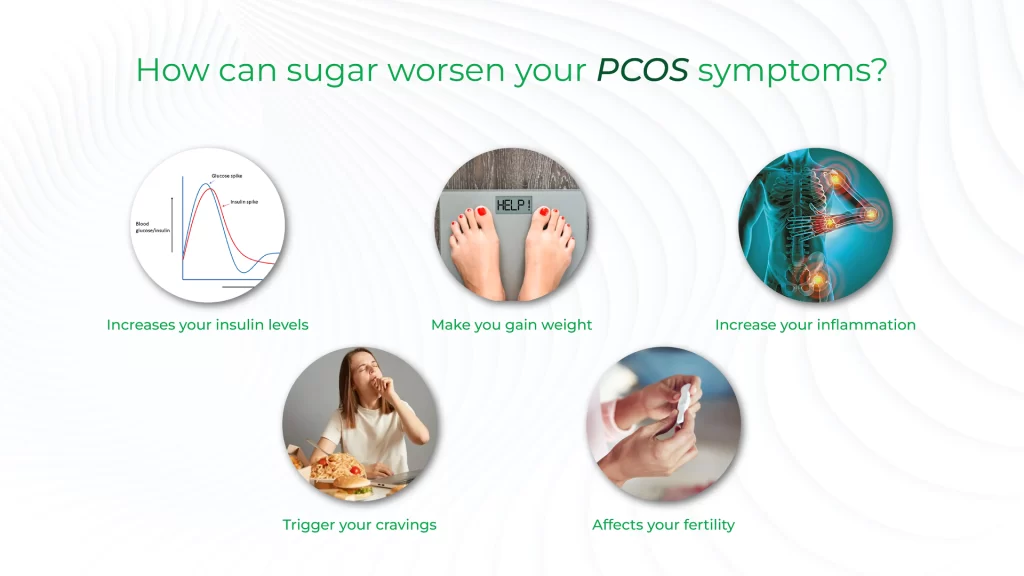
How can sugar worsen your PCOS symptoms?
Sugar can worsen your PCOS symptoms in the following ways:
Problem 1: Increases your insulin levels
High sugar intake can cause frequent spikes in your blood sugar, leading to chronically high insulin levels.
If you have PCOS, excessive sugar intake can:
- Worsen your insulin resistance
- Increase your androgen production
- Disrupt ovulation
Over time, this will make your PCOS symptoms harder to manage.
Problem 1: Increases your insulin levels
High sugar intake can cause frequent spikes in your blood sugar, leading to chronically high insulin levels.
If you have PCOS, excessive sugar intake can:
- Worsen your insulin resistance
- Increase your androgen production
- Disrupt ovulation
Over time, this will make your PCOS symptoms harder to manage.
Problem 2: Make you gain weight
Weight gain is both a symptom and a trigger for worsening PCOS.
If you have PCOS, excessive sugar intake can:
- Adds some empty calories to you.
- Increases your fat storage.
- Makes your weight loss more difficult.
Even a mild weight gain can intensify your hormonal imbalance in PCOS.
Problem 3: Increase your inflammation
PCOS is linked with low-grade chronic inflammation. High sugar diets are known to increase inflammatory markers in the body.
If you have PCOS, excessive sugar intake can:
- Make you feel worse fatigue.
- Increase acne in your body.
- Affect your ovarian function.
Problem 4: Trigger your cravings and crash your energy
Many women with PCOS experience the following after consuming excessive sugar:
- Make you have intense sugar cravings.
- Make you have mood swings.
- Make you have energy crashes.
This happens because fluctuating blood sugar levels affect both your hormones and brain chemistry.
Problem 5: Affects your fertility
High insulin and androgen levels can interfere with your ovulation.
For many women who are trying to conceive, excessive sugar intake can:
- Delay their ovulation
- Reduce your egg quality
- Increase the risk of infertility
Is all sugar bad for PCOS?
Not all sugar affects PCOS the same way as others. Natural sugars, especially those found in fruits, are generally safe and beneficial.
Fruits
contain fiber, antioxidants, and vitamins that slow sugar absorption, preventing sudden blood sugar spikes.
Honey
can be eaten while having PCOS, if it is consumed in small amounts. It still raises your blood sugar but has a gentler impact than refined sugar.
White sugar and other refined sugars
can be harmful when consumed in excess, as they quickly raise insulin levels and may worsen your PCOS symptoms.
Sugary drinks
like sodas and sweetened juices are strongly linked to insulin spikes because they contain high amounts of added sugar without fibre.
Processed snacks
such as cookies and packaged sweets are high-risk for PCOS, as they combine refined sugar with unhealthy fats.
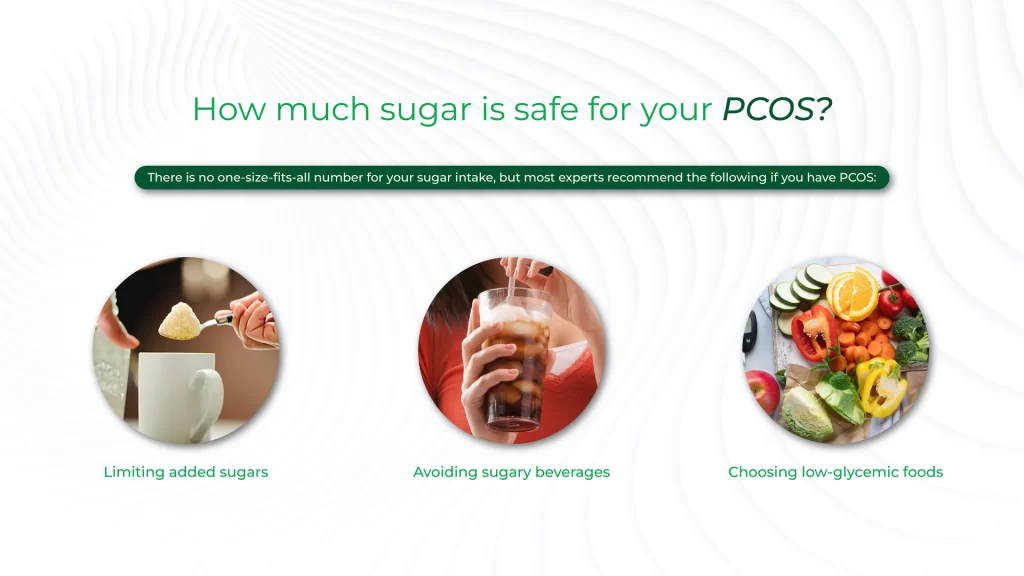
How much sugar is safe for your PCOS?
There is no one-size-fits-all number for your sugar intake, but most experts recommend the following if you have PCOS:
- Limiting added sugars
- Avoiding sugary beverages
- Choosing low-glycemic foods
The main goal for your PCOS is blood sugar balance, not total sugar elimination.
Can cutting sugar improve PCOS symptoms?
Yes, cutting sugar can improve your PCOS symptoms, as many women report improvements such as:
- They have more regular periods.
- They notice a reduction in acne.
- They have better energy levels.
- They find it easy to manage weight.
However, extreme restriction is not required and may even backfire on you by increasing your stress and cravings.
What is the role of the glycemic index in PCOS?
The glycemic index (GI) helps to measure how quickly your food raises blood sugar.
Low glycemic index foods, which are better for your PCOS, are as follows:
- Whole grains
- Legumes
- Vegetables
- Nuts
- Seeds
High glycemic index foods, which you should avoid for your PCOS, are as follows:
- White bread
- Sugary cereals
- Pastries
- Candy
Choosing low-GI foods will help you stabilize your insulin and reduce PCOS symptoms.
Does sugar cause PCOS?
No, sugar does not cause you PCOS. PCOS is a complex condition that is influenced by:
- Genetics
- Hormonal factors
- Lifestyle
- Metabolism
However, high sugar intake can worsen your existing PCOS symptoms especially in women with insulin resistance.
How is sugar and mental health linked with PCOS?
PCOS is often linked with anxiety, depression, and mood swings.
If you have PCOS, then Blood sugar fluctuations caused by sugar can worsen the following changes in your body:
- Irritability
- Brain fog
- Emotional eating
If you have stable blood sugar it will support both mental and hormonal health.
What are the practical tips you can follow to reduce sugar without feeling deprived?
You don’t need perfection to reduce your sugar intake, you just have to be consistent.
Here are some simple and realistic practical tips you can follow to reduce sugar without feeling deprived:
- You can swap soda with infused water
- Eat protein with carbs
- Choose fruits instead of desserts
- Read labels for hidden sugars
- Don’t skip meals
What do experts say about sugar and PCOS?
Medical professionals and registered dietitians generally say the following about sugar and PCOS:
- Reducing added sugar will improve your insulin sensitivity.
- Balanced diets work better than extreme diets for PCOS people.
- Long-term lifestyle changes matter more than short-term fixes.
What are the common myths about sugar and PCOS?
Myth 1: You must completely avoid sugar
Truth: Eating sugar in moderation and balance works well for PCOS.
Myth 2: Fruit sugar is bad for PCOS
Truth: Fruits are nutrient-dense and beneficial for PCOS.
Myth 3: Cutting sugar cures PCOS
Truth: PCOS has no cure, but symptoms can be managed by cutting sugar.
FAQs about sugar and PCOS
Q1: Does eating sugar cause PCOS?
Ans: No, sugar does not cause PCOS, but it can worsen symptoms in women who already have it.
Q2: Can I eat sweets if I have PCOS?
Ans: Yes, but occasionally. You can pair sweets with protein or you can eat them in moderation.
Q3: Is fruit sugar bad for PCOS?
Ans: No, fruit sugar is not bad for PCOS as fruits contain fiber and nutrients that help to regulate your blood sugar.
Q4: Will quitting sugar fix my PCOS?
Ans: Cutting sugar alone won’t fix your PCOS, but it can improve your PCOS symptoms when combined with a healthy lifestyle.
Q5: Is honey better than sugar for PCOS?
Ans: If taken in small amounts then yes honey is better than sugar for PCOS as honey has a lower glycemic impact than refined sugar.
Final thoughts
Excess sugar can worsen your PCOS symptoms, especially by increasing insulin resistance and hormonal imbalance. But sugar is not the only enemy for PCOS. Your real focus should be on the following practices:
- Reducing added sugars in your diet.
- Eating balanced meals.
- Supporting insulin health.
- Creating sustainable habits.
PCOS management is about progress, not perfection so you don’t need fear, you need understanding.